
Tallow vs. moisturizer: what's the difference?
Updated 2026-11-02
“Is a tallow balm a moisturizer?” is one of the questions we hear most. The short answer is that it is a kind of moisturizer, but a different kind from the cream or lotion most people picture. Knowing the difference makes it much easier to decide whether one belongs in your routine, and how to use it if it does.
What a moisturizer does
Moisturizers are usually described as working in three ways, and most products combine them (Purnamawati et al., 2017):
- Humectants draw water into the outer layer of skin. Glycerin and hyaluronic acid are familiar examples.
- Emollients fill the small gaps between skin cells, which is what makes skin feel smoother and softer.
- Occlusives form a layer that slows water escaping from the skin. Petrolatum and many waxes work this way.
That is research, and it is well established. Everything else in this article builds on it.
A typical cream or lotion
Most creams and lotions are emulsions: water and oil held together with an emulsifier. Water is often the first ingredient. Because water can grow bacteria and mould, a water-based product also needs a preservative system. The water makes the product feel light and quick to absorb, and the humectants in it help pull water into skin.
Creams like this suit a lot of people, especially those with normal or oily skin who want something light under makeup or sunscreen. There is nothing wrong with them, and we use them too.
A tallow balm
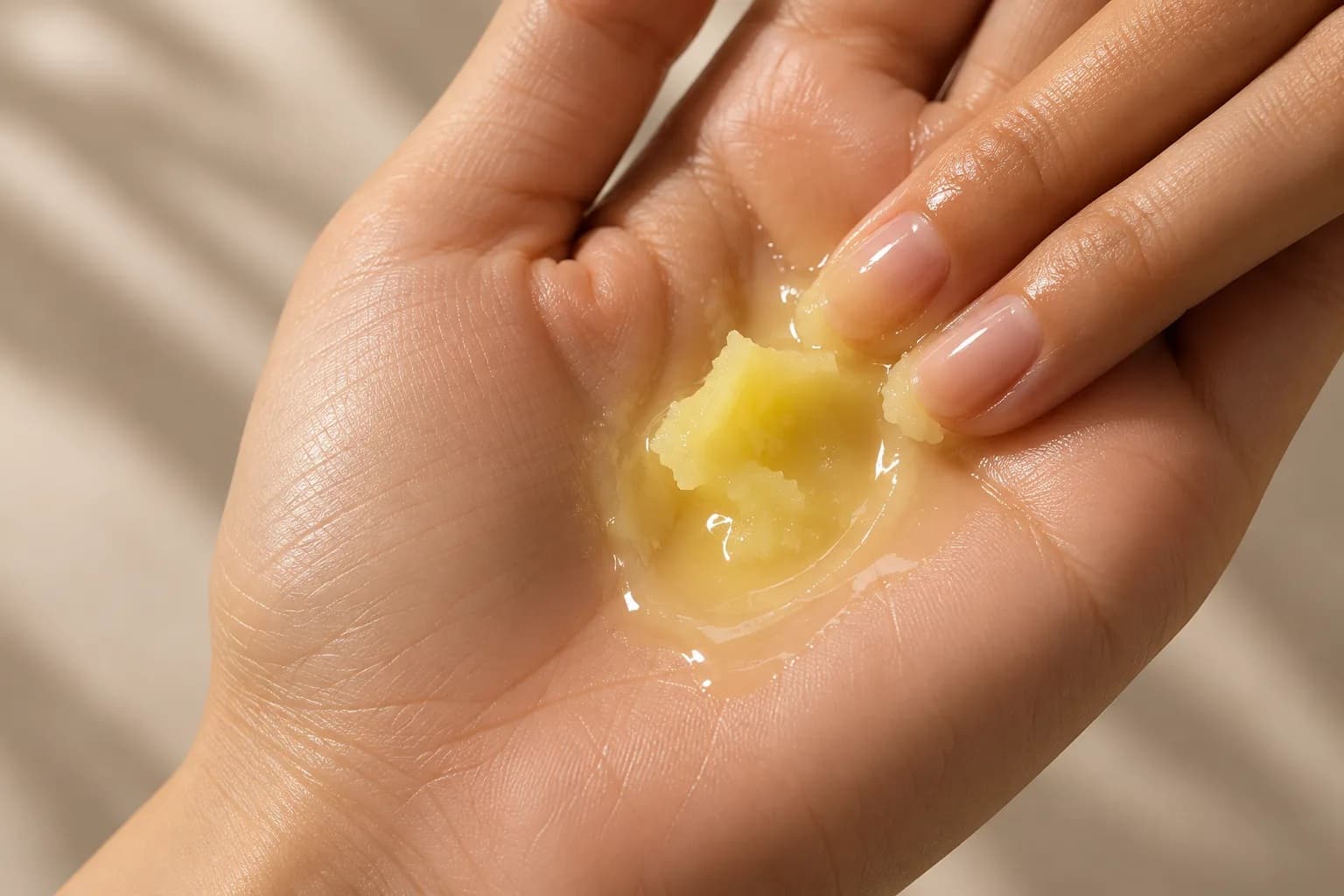
A tallow balm has no water. Ours are tallow, other oils, beeswax and vitamin E. With no water there is nothing for microbes to live in, so a balm does not need the preservative system a cream does, and the ingredient list stays short. The trade-off is texture: a balm is dense, and it is richer than a lotion.
In the terms above, a balm works mostly as an emollient and an occlusive. Tallow and jojoba soften and smooth, and beeswax helps seal in moisture. What a balm does not do on its own is add water. That is why the way you apply it matters, which we cover below.
There is one more reason we chose tallow over another oil, and we want to be careful about it. Sebum, the oil skin makes for itself, contains triglycerides and fatty acids including palmitic and oleic acid (Picardo et al., 2009), and tallow is largely made of triglycerides of those same fatty acids. That resemblance is real. Whether it makes tallow better for your skin than any other oil is not something we have seen tested, so we treat it as the reason for our choice, not as a promise.
Side by side
- Base: a cream is mostly water; a tallow balm is all oil and wax.
- Texture: a cream is light and quick; a balm is rich and melts into an oil with warmth.
- How it helps: a cream often combines humectants, emollients and occlusives; a balm is mostly emollient and occlusive.
- Preservatives: a cream needs them; a water-free balm does not need the same system.
- How much: a cream goes on generously; a balm is a pea-sized amount for the whole face.
What changes day to day
The practical differences show up in small ways. A cream can be smoothed on generously and forgotten; a balm asks for a pea-sized amount and a few seconds of warming between your fingertips. A cream tends to disappear quickly; a balm leaves a soft, low-shine finish for a minute or two while it settles. In our experience, that settled balm keeps dry skin comfortable for longer, which is why we reach for it at night and on cold, windy days, and why some people use a cream in the morning and a balm in the evening.
Storage differs too. A water-free balm reacts to temperature rather than drying out: it softens in a hot room and firms in a cold one, which is normal and does not mean it has spoiled.
Can you use both?
Yes, and many people do. In our experience the simplest way is to put on anything water-based first, a toner, a serum or a light cream, then press a little balm over the top to hold it in. You can also use a balm on its own on slightly damp skin, straight after washing.
How to choose
A balm is likely to suit you if your skin feels dry, tight or wind-worn by the end of the day, if you like a rich texture, or if you want a short ingredient list you can read in a few seconds.
A cream or gel is likely to suit you better if your skin is oily or prone to breakouts, or if you want something very light under makeup. A rich balm can feel heavy on oily skin, and we would rather tell you that than sell you a jar you will not use.
Whatever you choose, patch test a new product first. The American Academy of Dermatology suggests a small area such as the inside of your arm, twice a day for several days (AAD guidance). Tallow is beef-derived, so it is not vegan, and if you have alpha-gal syndrome or a beef allergy it is not for you.
If you want to see how a balm compares to what you use now, start with what tallow is, then try one of ours: the Yuja balm, the Green Tea balm, or both together as the Duo.
Sources
Try it yourself
The Tallow Duo
Both of our balms, so you can find the scent you reach for.
$68Bought separately $76Save $8Ships free