
What is tallow skincare?
Updated 2026-11-02
Tallow skincare is exactly what it sounds like: skincare built on tallow, which is rendered beef fat. If that makes you pause, it made us pause too, the first time. It is worth knowing what it actually is before deciding whether it belongs on your face.
This is how we think about it. We will try to keep three things apart, the way we promise to on our About page: what comes from tradition, what comes from published research, and what is simply our own experience of making and using it.
What tallow is
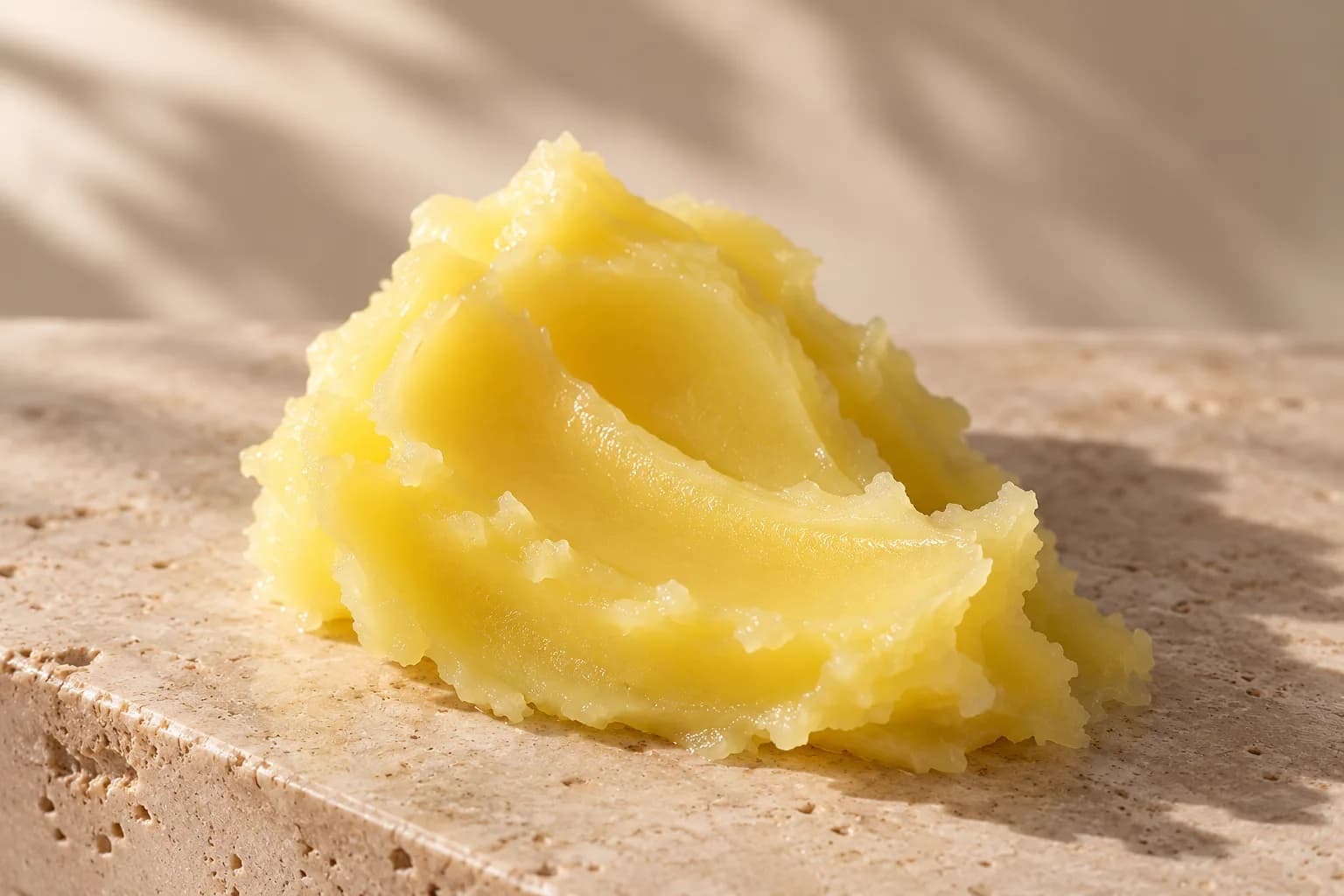
Tallow is fat from cattle (or sheep) that has been gently melted and filtered. When it cools it sets into a mild, near-white solid that is firm in the jar and softens with body heat. Ours comes from grass-fed cattle. It is a by-product of the beef industry: nobody raises an animal for its fat, and using it is one way of using more of what is already there.
Chemically, tallow is mostly triglycerides, which are three fatty acids attached to a glycerol backbone. The fatty acids in beef tallow are mostly oleic, palmitic and stearic acid, with smaller amounts of others (composition summary).
Why people put it on their skin
Tradition. Animal fats are among the oldest things people have rubbed into dry, wind-worn skin, and tallow was a common base for soaps, salves and balms long before modern lotions. Over the last century it fell out of fashion, mostly replaced by mineral oil, petrolatum and plant oils that are cheaper and easier to standardise. That history tells you people found it useful. It does not tell you why, or whether it suits you.
Research. The oil your skin makes for itself, sebum, is a mix of triglycerides and free fatty acids, wax esters and squalene, and palmitic and oleic acid are among the fatty acids it contains (Picardo et al., 2009). Tallow is largely triglycerides of some of those same fatty acids. That overlap is the reason tallow is often described as close to what skin already makes, and it is the reason we chose it. We want to be clear about the limit of that: it is a resemblance in composition. We have not found good published studies testing tallow balms on facial skin, so we do not make claims beyond the look and feel of skin.
Our experience. On our own skin, tallow goes on as a rich balm, melts into an oil with the warmth of your hands, and sinks in to a soft, low-shine finish rather than sitting on top. Dry, tight skin feels comfortable for longer. That is what kept us reaching for it, through years of trying everything else.
What a tallow balm usually contains
A tallow balm is usually tallow plus a few other oils and a wax, with no water. That last part matters: a cream or lotion is mostly water held together with emulsifiers, while a balm is all oil and wax, which is why it feels richer and why a little goes a long way. We explain the difference properly in Tallow vs. moisturizer.
Our balms keep the list short, six ingredients in the Yuja balm and seven in the Green Tea, and we explain why every one is there on the product pages: tallow as the base, jojoba for glide, beeswax for structure, vitamin E to keep the oils stable, and a botanical pair that gives each balm its character. The Yuja balm pairs distilled yuja peel oil with sea buckthorn. The Green Tea balm pairs green tea extract and pumpkin seed oil, with bergamot for scent.
The honest downsides
It is not vegan. Tallow is an animal fat. If you avoid animal products, tallow skincare is not for you, and we would rather say so plainly than bury it in an ingredient list.
It can feel heavy. A balm is richer than a lotion. If your skin is oily or prone to breakouts, a rich balm may simply be too much, and nothing we can say changes that. Start with a small amount on a dry area and see how your skin responds.
Patch test first. Any new product can disagree with your skin, including natural ones. The American Academy of Dermatology suggests trying a product on a small area, such as the inside of your arm or the bend of your elbow, twice a day for several days before using it more widely (AAD guidance). Stop if you see redness, itching or swelling.
Alpha-gal syndrome. Alpha-gal syndrome is an allergy to a sugar found in most mammals, and the CDC notes that some products other than food can contain it (CDC). Tallow is beef-derived. If you have alpha-gal syndrome or any beef allergy, talk to your doctor before using tallow skincare, and our honest advice is to skip it.
Who it might suit
In our experience, tallow balms suit people whose skin feels dry, tight or wind-worn, who like a rich texture, and who are happy with a short ingredient list they can read. They suit people less well if their skin is oily, if they prefer a light gel, or if they avoid animal products.
If you are curious, the simplest way to find out is to try a small amount and pay attention to how your skin feels over a couple of weeks. If you want to compare two scents while you do, both of our balms come together as the Duo.
Sources
Try it yourself
The Tallow Duo
Both of our balms, so you can find the scent you reach for.
$68Bought separately $76Save $8Ships free